Year: 2026

Shellfish Discombobulating Tool Set

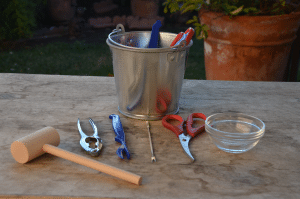
When sitting down, after cracking your knuckles, ready to begin your assault on a plate of shellfish, make sure you're prepared. We would like to help you with that by checking off the boxes in advance. A quality seafood tool set typically includes heavy-duty shell crackers, double-ended picks, and specialized shears designed to make breaking into crab, lobster, and shellfish effortless. Our shellfish discombobulating tool set includes them all including a wooden mallet and bowl for melted butter.

If you're into crab legs, lobster, clams, etc., you can use this set with zero instruction. A seafood boil comes to mind when thinking about this set. With it, you can easily crack, peel, and extract delicate meat from hard-shelled shellfish. This includes crabs, lobsters, crawfish, and shrimp without damaging the meat or making a mess. King crab legs have sharp, pointed shells that can dig into skin even if you're experienced.

The seafood scissors are perfect for slicing through shells of crabs and lobster. They match the shape of shells so you can cut cleanly without slipping or crushing the meat inside. They prevent hand injuries and messy shell fragments compared to regular kitchen knives or standard scissors. The crab mallet is a small, lightweight wooden hammer used to gently crack open the hard shells of crab claws and legs without smashing the delicate meat inside.

Shellfish Tool Set Value

What we like about it the most is the metal bucket for discarding shells. Shell fragments can blend into food on the plate and having a place to dispose of them is an excellent option. With exception of the wooden mallet, everything else is machine washable. Seafood crackers are pliers-style tools featuring textured, handles and serrated inner edges designed to crack hard claws and thick leg shells without crushing the meat inside. This shellfish discombobulating tool set has everything you need. These are the essential tools for eating crab legs and other shellfish. This is the perfect toolset for beginners.

Not to be a Debbie downer, and FYI, only cook and eat live crabs, and make sure they are fully cooked to prevent severe bacterial infections or parasites. Crab meat contains cholesterol and high levels of sodium. People managing heart disease, high blood pressure, or high cholesterol should eat it in moderation. Keep raw and cooked seafood strictly separated to avoid any harmful bacterial contamination.

Eating raw crab carries high risks of contamination from pathogens like Vibrio, Salmonella, and lung flukes. If you choose to eat raw marinated crab, it must be sourced live from highly reputable, pristine waters with explicit no-odor signs. Thorough boiling or steaming remains the safest preparation method. Also known as "dead man's fingers". These spongy, gray, feathery cones filter impurities. They are completely indigestible and taste terrible, though they are not inherently toxic. Pull them off and throw them away immediately.
.blockspare-6fb862a9-3cc3-4 .blockspare-block-button{text-align:center;margin-top:30px;margin-bottom:30px;margin-left:0px;margin-right:0px}.blockspare-6fb862a9-3cc3-4 .blockspare-block-button span{color:#fff;border-width:2px;font-size:16px}.blockspare-6fb862a9-3cc3-4 .blockspare-block-button .blockspare-button{background-color:#141618}.blockspare-6fb862a9-3cc3-4 .blockspare-block-button .blockspare-button:visited{background-color:#141618}.blockspare-6fb862a9-3cc3-4 .blockspare-block-button .blockspare-button:focus{background-color:#141618}.blockspare-6fb862a9-3cc3-4 .blockspare-block-button i{font-size:16px}.blockspare-6fb862a9-3cc3-4 .blockspare-block-button a{padding-top:12px;padding-bottom:12px;padding-right:22px;padding-left:22px}@media screen and (max-width:1025px){.blockspare-6fb862a9-3cc3-4 .blockspare-block-button span{font-size:14px}.blockspare-6fb862a9-3cc3-4 .blockspare-block-button i{font-size:14px}}@media screen and (max-width:768px){.blockspare-6fb862a9-3cc3-4 .blockspare-block-button span{font-size:14px}.blockspare-6fb862a9-3cc3-4 .blockspare-block-button i{font-size:14px}}

Sauces Make The World Go Round

Sauces come in many textures, uses, and flavors. They range from simple sauces like mustard, hot sauce, ketchup, mayonnaise just to name a few. And then there are the more complex sauces like the ones used for dipping, BBQ, and dishes from all around the world. The official designation for sauces is "a liquid or semisolid food mixture used especially as a topping or ingredient for adding to or enhancing the flavor of a dish".

Records of sauces dating from around 200 AD and attributed to Apicius, an authoritative text of cooking from ancient Rome, include highly seasoned preparations containing herbs, spices, vinegar, honey, and a form of fermented fish sauce called garum. These sauces were usually prepared with a mortar and pestle and thickened with pounded rice, nuts, or bread. From Roman times to the Middle Ages, dating around the 14th century, European sauce preparation hasn’t changed much.

In Western culture, the French revolutionized the preparation of sauces and methodically organized a system of uniform recipes that few other cultures could rival. These sauces established a systematic way to efficiently produce thousands of sauce and soup variations based on five grande sauces. Escoffier in Le Guide Culinaire lists almost 80 small derivative sauces based on the grande sauces.

Our Sauces Make The World Go Round

Tracing the history of barbecue sauces in America is difficult because there are very few barbecue sauce recipes to be found in early cookbooks. A few recipes for true barbecue, usually open-pit style, have been passed down in English and French literature of the seventeenth and eighteenth centuries. In Nouveaux Voyages aux Isles d’Amerique by Jean B. Labot (1693), there is a description of a barbecued whole hog that is stuffed with aromatic herbs and spices, roasted belly up, and basted with a sauce of melted butter, cayenne pepper, and sage. The fragrant meat was sliced and served on leaves of an aromatic West Indian plant.

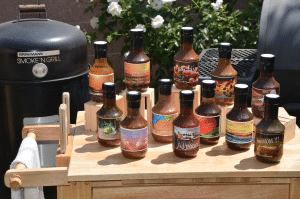
To say sauces make the world go round is a misnomer because on BBQ, everyone does not use sauces. We make our own sauces. The main difference is that ours are additive and preservative free. The benefit our sauces is the ingredients are easily identifiable. They have been blended to deliver a specific flavor. Some are even made with real fruit. Having said all that, they do have special handling ingredients like refrigeration before and after use. This is to stop the natural process associated with fruit. Click the button below and take a look at our sauces. You won't be disappointed.

.blockspare-e318c7a6-7c81-4 .blockspare-block-button{text-align:center;margin-top:30px;margin-bottom:30px;margin-left:0px;margin-right:0px}.blockspare-e318c7a6-7c81-4 .blockspare-block-button span{color:#fff;border-width:2px;font-size:16px}.blockspare-e318c7a6-7c81-4 .blockspare-block-button .blockspare-button{background-color:#141618}.blockspare-e318c7a6-7c81-4 .blockspare-block-button .blockspare-button:visited{background-color:#141618}.blockspare-e318c7a6-7c81-4 .blockspare-block-button .blockspare-button:focus{background-color:#141618}.blockspare-e318c7a6-7c81-4 .blockspare-block-button i{font-size:16px}.blockspare-e318c7a6-7c81-4 .blockspare-block-button a{padding-top:12px;padding-bottom:12px;padding-right:22px;padding-left:22px}@media screen and (max-width:1025px){.blockspare-e318c7a6-7c81-4 .blockspare-block-button span{font-size:14px}.blockspare-e318c7a6-7c81-4 .blockspare-block-button i{font-size:14px}}@media screen and (max-width:768px){.blockspare-e318c7a6-7c81-4 .blockspare-block-button span{font-size:14px}.blockspare-e318c7a6-7c81-4 .blockspare-block-button i{font-size:14px}}

Circle or J-Hooks – What’s your Pleasure?

I've been a fisherman for more years than I would like to believe. Like everything else, old habits are hard to break or change. So when trying something new, it's considered evolution. For years, I used the basic J-Hook and caught plenty of fish. Threw back many undersized fish as well. I always wondered how many deep-hooked fish recovered, how long it took to recover, and if, in fact, they lived. On this trip, I was wondering if I should be using circle or J-Hooks.

Fishing for me has always been a means to a good meal. Catch-and-release has never been my style. You get caught, you get cleaned, and you get eaten. A local tackle shop introduced me to circle hooks, saying the hookup ratio would be higher once you learned how to use them. So I figured I'd take a cut at evolution; what could go wrong other than catching fewer fish?

So we anchored up at San Clemente Island off the California coast, just outside a kelp forest. I pinned on a large Anchovy on my 15lb bass rig and tossed it into the kelp. A calico bass boiled on the bait and took off. I had my thumb on the spool still and was attempting to put the reel in gear. Unbeknownst to me, the bait inhaled within seconds of hitting the water, so I did not swing as I would have with a J-Hook. So essentially, I hooked up the first time using a circle hook as designed. The hook lodged in the corner of the fish's mouth exactly where it was supposed to be. The bass was undersized, and removing the hook from the corner of the fish's mouth proved the worth of circle hooks.

Circle or J-Hooks - Preference or Mandate?

To this day, I still use J-Hooks. In fact, we got into a wide-open bite on Yellowtail. I had a J-Hook tied onto grey 25lb test and went 4 for 4 that day using Sardines. In freshwater, I primarily use J-Hooks. I fish for easily caught fish on anything for no particular reason. In saltwater, I prefer circle hooks, usually in red. "I use red hooks because some guys get frustrated when they don’t catch anything and claim other anglers' fish while sorting out tangles." I simply point to the red circle in the corner of the fish's mouth, and the argument ends.

So what are your experiences, Circle or J-Hooks? And while you're at it, take a look at what we sell and use in our tackle store. Any fisherman claiming they have enough or too much tackle hasn't been fishing long.......

.blockspare-2bb23f36-aca8-4 .blockspare-block-button{text-align:center;margin-top:30px;margin-bottom:30px;margin-left:0px;margin-right:0px}.blockspare-2bb23f36-aca8-4 .blockspare-block-button span{color:#fff;border-width:2px;font-size:16px}.blockspare-2bb23f36-aca8-4 .blockspare-block-button .blockspare-button{background-color:#141618}.blockspare-2bb23f36-aca8-4 .blockspare-block-button .blockspare-button:visited{background-color:#141618}.blockspare-2bb23f36-aca8-4 .blockspare-block-button .blockspare-button:focus{background-color:#141618}.blockspare-2bb23f36-aca8-4 .blockspare-block-button i{font-size:16px}.blockspare-2bb23f36-aca8-4 .blockspare-block-button a{padding-top:12px;padding-bottom:12px;padding-right:22px;padding-left:22px}@media screen and (max-width:1025px){.blockspare-2bb23f36-aca8-4 .blockspare-block-button span{font-size:14px}.blockspare-2bb23f36-aca8-4 .blockspare-block-button i{font-size:14px}}@media screen and (max-width:768px){.blockspare-2bb23f36-aca8-4 .blockspare-block-button span{font-size:14px}.blockspare-2bb23f36-aca8-4 .blockspare-block-button i{font-size:14px}}

Black vs. White Pepper – Is There A Difference?

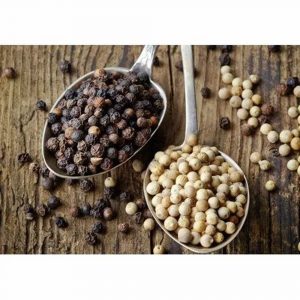
So you're preparing a fantastic meal for friends, and somebody asks you when to use one pepper vs. the other. Being generous, I can say it really depends on taste in deciding black vs. white pepper. Black pepper often serves as an everyday seasoning, while white pepper serves more as a specialist item. The key differentiator driving the taste is the fermentation process.

To make white pepper, someone soaks fully ripened black peppercorns in water for several days (a process called retting). This allows microbes to break down and shed the tough outer skin, leaving only the pale inner seed. This rotting/soaking process releases volatile compounds that leave behind earthy, barnyard, or manure-like odors. On the good side, white pepper is anti-inflammatory and may lower blood pressure. It makes it heart-friendly. Thanks to its benefits in lowering blood pressure, white pepper regulates blood flow. It may result in the prevention of heart attacks. The wind leaves the berries on the vine until they are fully ripe and turn a deep red or yellow.

Black pepper, often called the “King of Spices,” has a rich history spanning millennia. It originates in the tropical forests of the Malabar Coast in Kerala, India. From its humble beginnings, this potent spice became a symbol of wealth, drove empires, and reshaped global trade. For everyday culinary use in normal amounts, black pepper is highly beneficial. But taking medicinal-level supplements can be hard on the Stomach and may interfere with prescribed medications processed by the liver. Farmers harvest the berries (or "peppercorns") while they are still unripe and green. They then briefly cook them and leave them to dry in the sun. During this drying process, enzymes cause the outer skin to shrink, shrivel, and turn black.

Sourcing Black vs. White Pepper

White and black pepper come from the exact same plant (Piper nigrum). White and Black pepper differ drastically in how they are harvested and processed. Black pepper is stronger, sharper, and leaves dark flecks. White pepper is milder, earthier, and blends seamlessly into light-colored dishes. They’re harvested in clusters and dried in the sun or by machine until the outer shell, or pericarp, shrinks. It then becomes wrinkled and dark brown. White pepper is milder and has fewer essential oils. This can make it gentler on the stomach for individuals who experience digestive discomfort from black pepper.

Chefs prefer white pepper for two primary reasons: flawless presentation and a distinct, earthier flavor profile. Because its dark outer skin has been removed, it offers the heat and complexity of pepper. The benefit is does not leave dark specks in light-colored dishes. So when making the decision on using black vs. white pepper, we recommend trying both. We have both to offer in our online store under the category of "Everyday Spices".

.blockspare-5ff455f4-7550-4 .blockspare-block-button{text-align:center;margin-top:30px;margin-bottom:30px;margin-left:0px;margin-right:0px}.blockspare-5ff455f4-7550-4 .blockspare-block-button span{color:#fff;border-width:2px;font-size:16px}.blockspare-5ff455f4-7550-4 .blockspare-block-button .blockspare-button{background-color:#141618}.blockspare-5ff455f4-7550-4 .blockspare-block-button .blockspare-button:visited{background-color:#141618}.blockspare-5ff455f4-7550-4 .blockspare-block-button .blockspare-button:focus{background-color:#141618}.blockspare-5ff455f4-7550-4 .blockspare-block-button i{font-size:16px}.blockspare-5ff455f4-7550-4 .blockspare-block-button a{padding-top:12px;padding-bottom:12px;padding-right:22px;padding-left:22px}@media screen and (max-width:1025px){.blockspare-5ff455f4-7550-4 .blockspare-block-button span{font-size:14px}.blockspare-5ff455f4-7550-4 .blockspare-block-button i{font-size:14px}}@media screen and (max-width:768px){.blockspare-5ff455f4-7550-4 .blockspare-block-button span{font-size:14px}.blockspare-5ff455f4-7550-4 .blockspare-block-button i{font-size:14px}}